DNA is a blueprint of life. It helps scientists decode the intricacies of life on Earth. It also allows us to understand diseases and how traits are inherited.
Some common applications of DNA are disease diagnosis, forensic investigation, biological identification, GMOs & crop improvements, animal migration tracking, pathogen detection and more.
It is therefore employed in many interdisciplinary contexts in routine work.
But as a student, you may have a question: “How do scientists actually study DNA?”
Let’s understand the common procedure used in almost all types of DNA investigations.
Stay tuned.
Key Topics:
DNA-based investigations:
Firstly, it is a stepwise process that includes both wet lab work (real lab experimentation) and dry lab work (computational analysis). Note that for both investigations, beginner-level skills are needed.
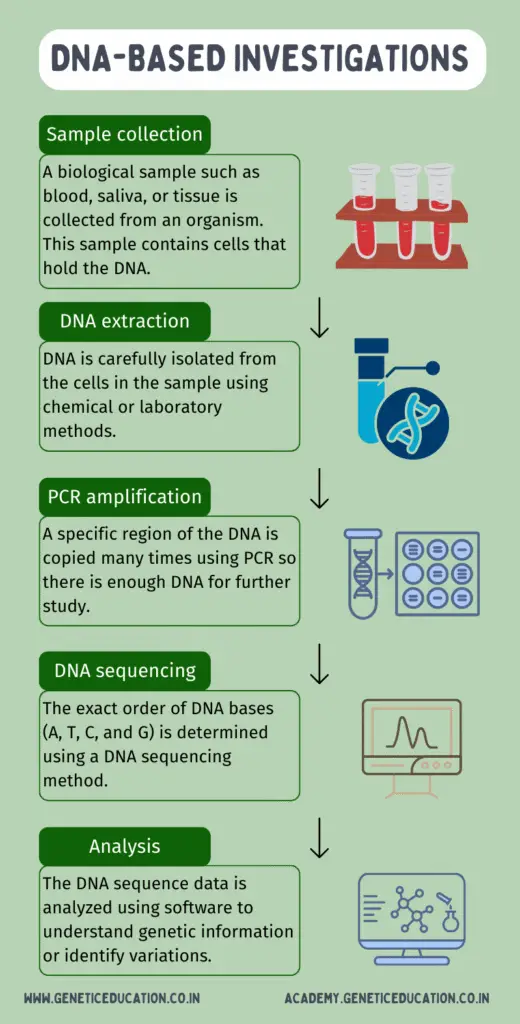
Common steps for DNA-based investigations are sample collection, DNA extraction, PCR amplification, DNA sequencing and analysis.
Sample collection
Any biological sample that contains DNA, as the genetic material, can be investigated—for instance, human, plant, animal or bacterial samples. Even samples thousands to millions of years old can be processed if they have intact DNA.
It is ideally recommended to transport crucial samples like blood or tissue at 4 °C. Room temperature is also fine.
DNA extraction
Now, the next step is isolating DNA from the sample. Lab personnel used either enzymatic, chemical or physical methods to isolate DNA from the sample.
Isolation or extraction simply means collecting DNA from a cell by disrupting the cell wall/membrane and nuclear membrane.
However, DNA purification is required to get a good quality and quantity of DNA for the experiment. You can read our previous article on DNA extraction to know more.
After this step, we have our DNA for study.
PCR amplification
We want to study a specific fragment or gene, and for that, the number of copies of that particular fragment is not sufficient in our DNA sample for the analysis.
To overcome this, we amplify DNA using PCR, which can generate millions of copies of a specific gene or DNA fragment.
To do so, a PCR amplification reaction is prepared, run in a thermocycler, and analyzed by agarose gel electrophoresis. Read our previous article using the provided links to learn more about each step.
Explore the article on PCR amplification.
After this step, we have copies of our fragment of interest for study.
DNA sequencing
DNA sequencing is a process of decoding each nucleotide from a target or fragment of interest.
To do so, the amplicons are used to prepare the sequencing reaction and run in a capillary electrophoresis system. The system generates an electropherogram, a digital representation of the DNA sequence.
Explore our articles on DNA sequencing.
Analysis
Once we have the DNA sequence, we can perform computational analysis to identify disease-causing mutations, compare it with other samples or DNA sequences to find a match and use it to investigate GMs.
Various tools and software are used for each type of analysis.
Wrapping up:
This is a rough or we can say, a broad overview of a DNA-based analysis. The process is (almost) similar for all types of analysis; only the end results may vary. DNA-based investigations are highly accurate, reliable and fast.
Henceforth, it is widely used in various disciplines and interdisciplinary fields. In the upcoming articles, we will explore each application and understand the process.