
Karyotyping is a cytogenetic technique used to investigate chromosomes. It is a gold-standard technique for prenatal and postnatal analysis.
It is the most important and stand-alone technique that doesn’t have any automation yet! Meaning, scientists need to investigate each karyotype manually. However, it requires effort and specialized training to learn karyotype analysis.
If you are a genetics student or a cytogenetics practitioner, this article will help you learn the basic process of investigating a chromosome.
This article also lets you understand the karyotype analysis procedure.
Let’s start!
Key Topics:
How to analyze a karyotype?
A karyotype is prepared to investigate two types of chromosomal abnormalities: numerical and structural. But before beginning the investigation, scientists need to arrange each chromosome in pairs.
Here are the steps that need to be followed.
Step 1: Check the quality of the field:
First, look for the quality of the field. Every chromosome should look crystal clear. Check for banding pattern, field spread, chromosome overlapping and quality.
Avoid unstained, poor-quality and messy fields. In addition, look for any visible contamination in the culture. If everything looks amazing, you can go ahead.
Step 2: Count the chromosomes:
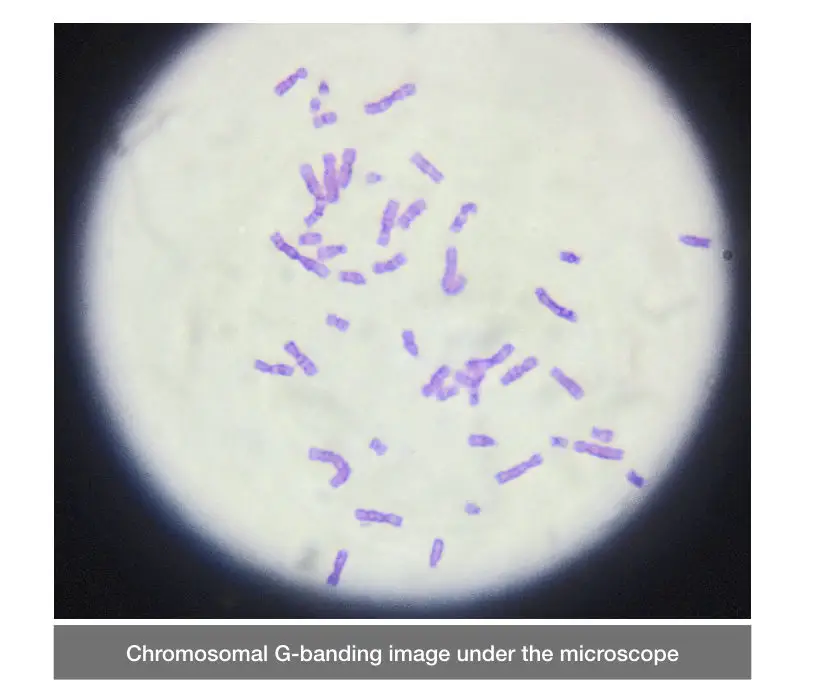
Next, choose the best metaphase field and start the investigation. Start with counting!
Count the number of chromosomes in the field and note down the numbers. If abnormal numbers are counted, also note that. This will help in future investigations.
Choose 15 to 20 good-quality metaphases for investigation. Do the same counting for all fields. The number should be uniform for all the selected fields.
Step 3: Understanding the chromosome groups:
Next, investigate each field one by one and arrange chromosomes in groups.
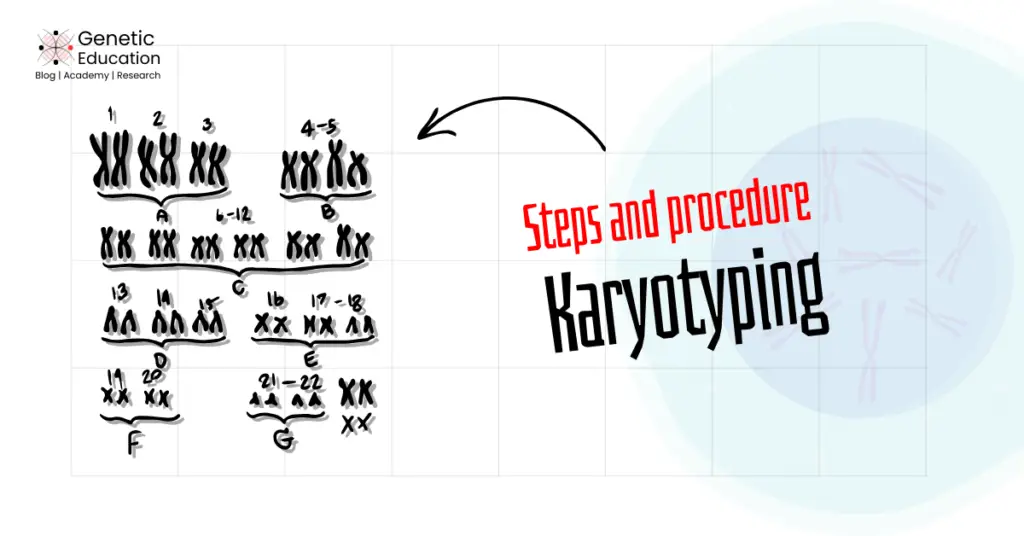
Chromosomes are grouped into A to G based on the location of the centromeres. Common types of chromosomes observed in a human karyogram are large metacentric, submetacentric and acrocentric and smaller to medium metacentric, submetacentric and acrocentric.
The key to mastering the karyotype investigation is to understand the chromosome groups very keenly and to do that, you need to understand the unique characteristics of each chromosome.
Unique properties of each chromosome:
Chromosomal groups are the first line of investigation, where you can group chromosomes based on the location of the centromere and the size or length of the chromosome.
After that, you need to keenly observe individual chromosomes and identify their banding patterns.
GTG banding prepares a unique banding pattern for each chromosome and shows distinct dark, light and white bands on chromosomes.
The beauty here is… it varies from chromosome to chromosome.
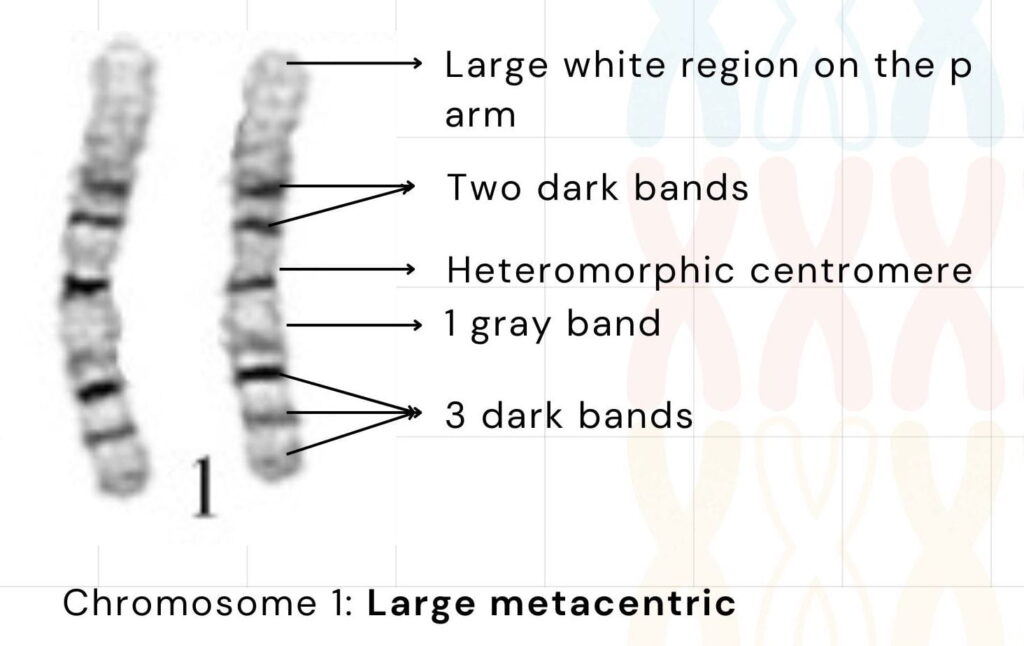
For example, chromosome 1 is a large metacentric chromosome. It has a huge white region on the very end of the p arm. It also has two dark bands in the middle of the p arm and two dark bands on the q arm.
Two dark bands on the p arm are in the middle and at equidistance. In addition, multiple other dark and grey bands also appear in the q arm.
These are the main characteristics of chromosome 1.
In our karyotyping masterclass, my team has explained the unique characteristics of every chromosome, which help you to understand the karyotype effectively.
You can join the course to master your karyotyping analysis knowledge.
Step 5: Look for the abnormalities:
Now look for the abnormalities in the karyogram. You now have a completely arranged karyotype. First, look for the numerical abnormality, if any chromosome is missing or extra in the karyotype.
Then look for common structural abnormalities like translocations, insertions, or deletions.
Note: Keep in mind that to understand structural chromosomal abnormalities, you need to practice karyotyping and master the banding pattern.
Step 6: Report ISCN:
Once you have investigated the karyotype, you need to report the results in the form of ISCN. Use symbols and punctuation accurately. Refer to the ISCN guide or join our course to learn about the ISCN nomenclature.
Step 7: Verify the karyotype:
Now! Hand over the report or investigated karyotype to an expert geneticist and verify the results before reporting it.
Wrapping up:
These are the simple roadmap or steps that you have to follow every time to investigate a karyotype. Keep in mind, karyotyping is a manual yet important genetic investigation; it requires practice and years of experience to understand and arrange the karyotype.
Download our karyotype reporting template and join our online course to learn the technical side, including the procedure, protocol, problems and troubleshooting and analysis side to arrange the karyotype.