Snippet:
Some cells stay active for hours to 1–2 days after death.
Gene activity can be detected for 1–4 days after death.
Brain cells die in minutes, skin and bone cells last for days.
DNA starts degrading within hours and fragments within days.
Bacteria grow rapidly within 12–24 hours and drive decomposition.
Death is inevitable and pre-decided by destiny. Every organism dies eventually, regardless of whether they want to or not. Scientifically, death means our cellular machinery stops working.
But what happens to our DNA?
Scientists have recently recovered DNA that is more than 2 million years old. DNA remains even after death. But how and how long?
Let’s find out.
Read more: From 20,000 Human Genes, This Indian Scientist Found One — And Many More Are Yet to Come.
Key Topics:
Death Scientifically:
An organism is considered dead when the body stops working, including movement, breathing, heartbeats and brain function. Science divided death into three stages: clinical death, cellular death and Rigor mortis.
It starts with clinical death when breathing and heartbeat stop. Soon after, cells undergo autolysis, which is cellular death, and then muscle stiffness, energy release and death. During this whole process, DNA doesn’t die immediately… or never.
Let’s understand what happens to our DNA in the step-by-step process.
What Happens to Our DNA When We Die?
Ok, so first, breathing stops, cells can not get the fuel to run cellular processes- the oxygen. Hypoxia causes oxidative stress in the cellular environment. Immediately, chaos occurs at a cellular level.
Next, ATP (energy) production stops; thus, cells can not control the DNA repair process, enzymatic activities and membrane structure. Now, cellular decay initiates and is inevitable.
All cellular activities disrupt and lead to panic at the DNA level. Now, cellular machinery continues to stop one by one. Cells lose their control over replication, transcription and translation.
Lacking a cell membrane, enzymes leak out and the immediate action is that cellular nucleases start attacking the DNA.
DNA is chopped into fragments and this initiates the decomposition process. Note that nucleases remain active for a long time even after death.
Our body hosts trillions of microbes, which initiate cellular attack in the absence of the immune system. This accelerates the DNA damage and decomposition process.
After this, environmental factors take over. UV rays, chemicals, heat, wet atmosphere and oxygen chop down DNA further. The DNA fragmentation process continues until only DNA bases remain.
Heat accelerates chemical reactions, moisture activates enzymes, oxygen causes oxidative stress and nourishes microbes; these conditions speed up DNA decay.
However, certain climatic conditions, such as dry atmosphere, lack of oxygen and extreme cold, protect DNA from decay and store DNA for a long time. That’s the reason we get DNA fragments mostly from the frozen or desert parts of the world.
Several studies showed some interesting facts on how our DNA behaves after the death of an organism. It shows that a certain set of genes immediately activates when cellular decay initiates.
A study by Pozhitkov, A. E., et al. (2017) demonstrated that more than 1000 gene transcripts increase after death. These genes are linked to immunity, stress response, inflammation, development or even cancer.
Researchers from the University of Illinois Chicago also reported an increased level of certain genes in the brain, even after 10 hours of death.
Now, this doesn’t mean that the body is coming back to life; this shows that there are still backup mechanisms that try hard to make cells survive.
Meaning, our DNA always tries to survive even after death. But…Death is inevitable!
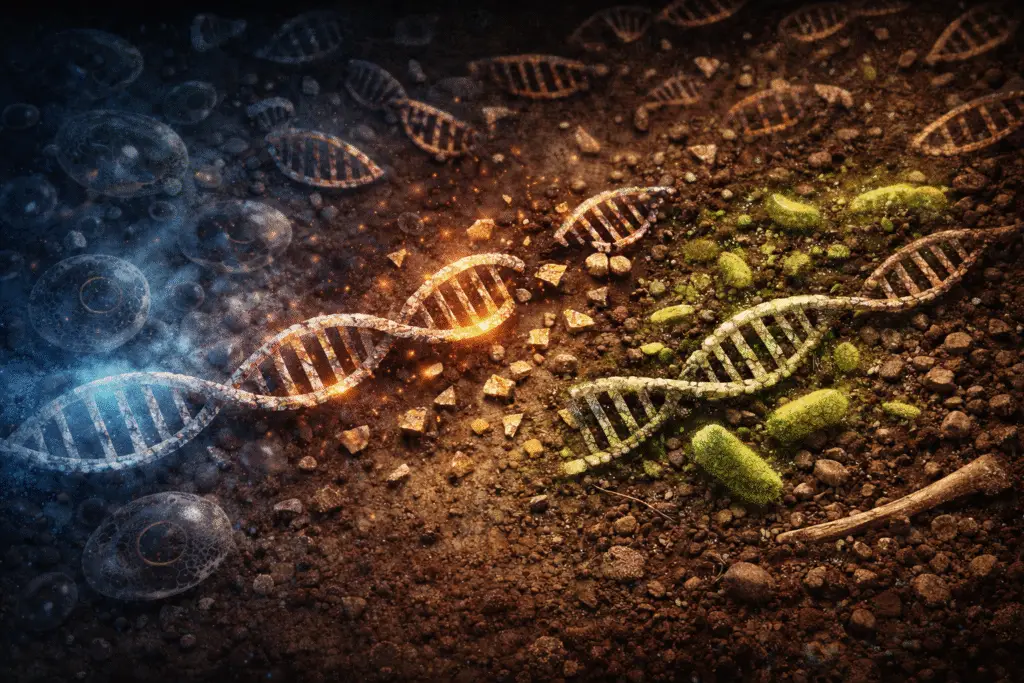
After a course of time, everything decays, but DNA fragments remain. For days, years or millennia!
Read more: An Expert Explains Why the 385-Million-Year Symbiosis Between Corals and Algae Is At Risk.
Wrapping up:
In conclusion, after death, everything vanishes, but not DNA. Scientists capture such DNA fragments, read them, arrange them fragment by fragment and reconstruct the blueprint of life again.
By doing so, scientists understand life, but can not recreate it. Subscribe to Genetic Education for more stories, research and insights.
Sources:
Pozhitkov, A. E., et al. (2017). Tracing the dynamics of gene transcripts after organismal death. Open Biology. DOI: 10.1098/rsob.160267.
Dachet, F., Brown, J.B., Valyi-Nagy, T. et al. Selective time-dependent changes in activity and cell-specific gene expression in human postmortem brain. Sci Rep 11, 6078 (2021). https://doi.org/10.1038/s41598-021-85801-6.