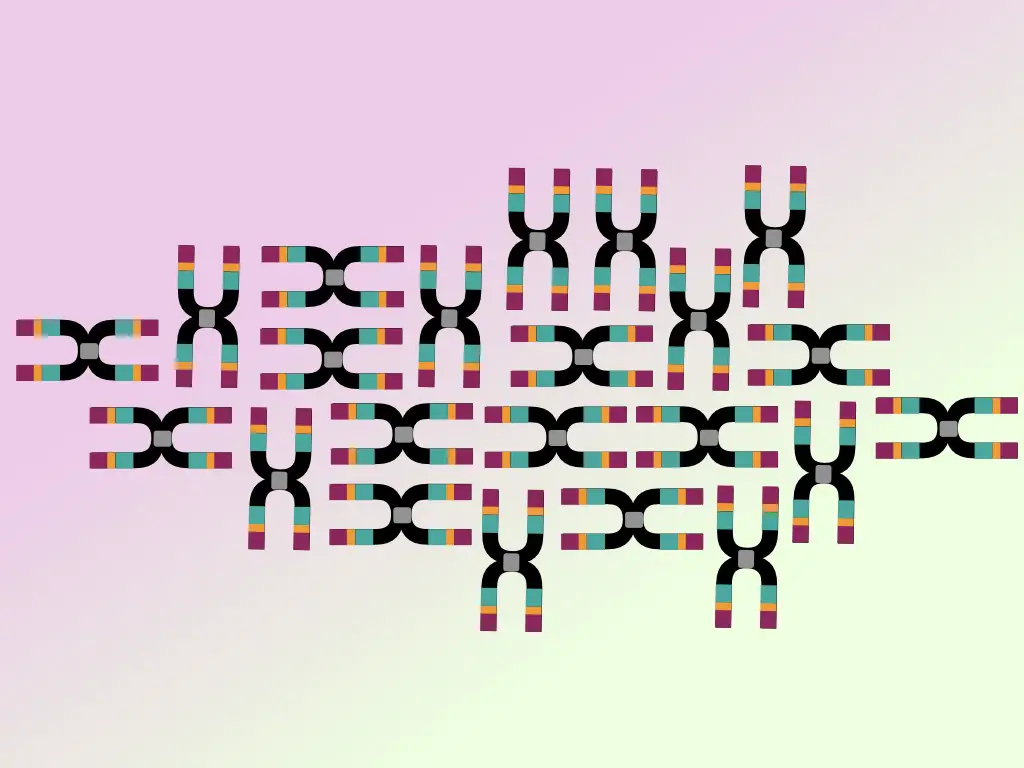
Karyotyping has been part of cytogenetics for decades. It is one of the oldest techniques tos tudy chromosomes, and for many years, it was central to the diagnosis of chromosomal disorders.
But the field has changed.
Today, laboratories can use chromosomal microarray (CMA), next-generation sequencing (NGS), optical genome mapping (OGM), EGM and other genomic technologies to examine the genome at a much higher resolution.
That naturally raises a question:
Is karyotyping slowly heading towards a dead end?
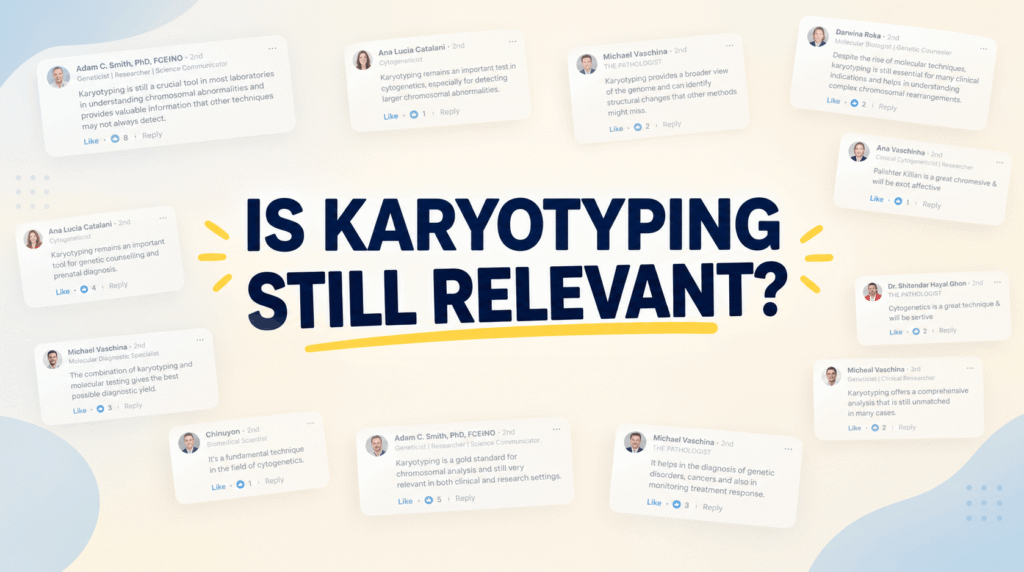
I asked this question on LinkedIn because I did not want a textbook answer. I wanted to hear from people working in cytogenetics, genomics, genetic counselling and diagnostics. Meaning, people who see these technologies being used in real clinical settings.
The responses did not point to one simple conclusion.
Some experts believe karyotyping will remain clinically important for many years. Others think newer technologies will gradually take over some of its applications. A few suggested that the future may not be about replacing one technology with another, but about combining different technologies to answer different parts of the same clinical question.
The discussion also revealed something else: the future of karyotyping may depend not only on its scientific value, but also on cost, accessibility, reimbursement, automation and the changing role of the cytogeneticist.
And here I am summarising the discussion with experts.
Key Topics:
Why does karyotyping still matter?
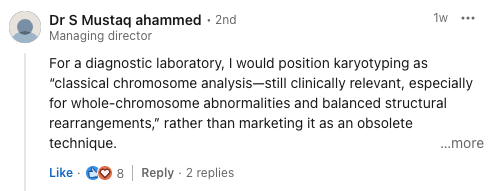
One of the clearest answers came from Dr. S Mustaq ahammed, who described karyotyping as:
“Karyotyping as classical chromosome analysis—still clinically relevant…”
He specifically referred to its value in detecting whole-chromosome abnormalities and balanced structural rearrangements, ending with the familiar phrase:
“Old is Gold.”
That phrase may sound simple, but it captures an important point.
A technology does not become irrelevant merely because newer technologies have arrived. Its value depends on the clinical question it can answer.
Karyotyping can reveal changes in chromosome number and large-scale chromosome structure. It can show an extra chromosome, a missing chromosome or a major rearrangement that may not be the primary focus of a sequence-based test.
So the question is not whether karyotyping is old or new.
The more useful question is:
Does it still provide information that matters to the patient?
The patient often determines which test is useful
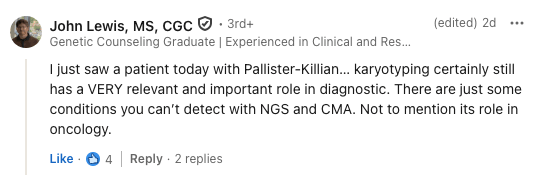
John Lewis, MS, CGC, brought the discussion back to clinical reality.
He wrote:
“I just saw a patient today with Pallister-Killian…”
He then explained that karyotyping still has a:
“VERY relevant and important role”
because some conditions may not be detected using NGS and CMA alone. He also mentioned its continuing importance in oncology.
This is an important reminder. Technology comparisons can look very clear on paper, but patients do not always fit neatly into those comparisons.
A test may have excellent resolution and still miss the particular type of abnormality suspected in a patient. Another test may be less detailed overall but better suited to identifying a specific chromosomal pattern.
That is why the first question should not be:
Which technology is the most advanced?
It should be:
What are we trying to find?
The answer should guide the choice of test.
Resolution is not the same as information
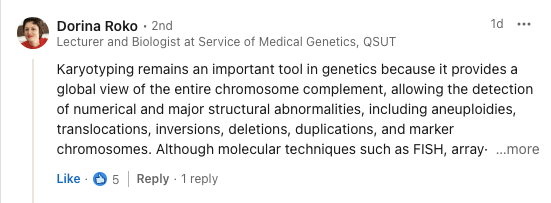
Dorina Roko offered one of the more detailed explanations of karyotyping’s continuing role.
She described it as providing:
“a global view of the entire chromosome complement”
and explained that it can detect numerical and major structural abnormalities.
She also made an important distinction. FISH, array-CGH and NGS may provide higher resolution, but karyotyping offers information about chromosome structure and organisation that is not identical to what those technologies provide.
This distinction is easy to miss.
When we say that one technology has higher resolution, we often assume that it must therefore be better in every situation. But different technologies show the genome at different scales.
CMA can identify small copy-number changes. NGS can detect sequence-level variants. Karyotyping provides a broad chromosome-level view.
These are not necessarily competing views. They are different views of the same genome.
That is why karyotyping continues to have a role in chromosomal disorders, reproductive genetics and haematological malignancies, often alongside molecular testing rather than instead of it.
Accessibility is part of clinical value
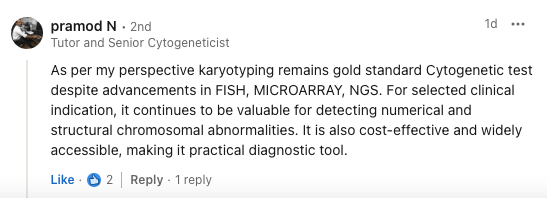
Pramod N described karyotyping as a continuing “gold standard” cytogenetic test for selected clinical indications.
He highlighted its usefulness in detecting numerical and structural chromosomal abnormalities, but he also drew attention to two practical advantages:
cost-effectiveness and accessibility.
These points are sometimes overlooked when we discuss the future of laboratory medicine.
A test may be technically impressive, but if it is expensive, difficult to access or unavailable in many laboratories, it may not immediately become the routine choice everywhere.
Karyotyping is familiar to many laboratories. It has established workflows, trained professionals and a long history of clinical use. In many settings, those practical advantages still matter.
Not every laboratory has access to the same instruments, bioinformatics support or financial resources. The most advanced technology is not always the most realistic technology for every healthcare system.
Will sequencing eventually take over?
Not everyone in the discussion was equally optimistic about karyotyping’s long-term position.
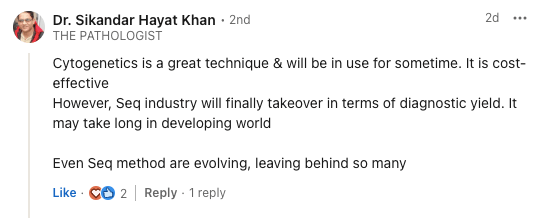
Dr. Sikandar Hayat Khan described cytogenetics as:
“a great technique & will be in use for sometime”
but suggested that the sequencing industry may eventually take over in terms of diagnostic yield. He also noted that this transition may take longer in developing countries.
This is a reasonable possibility.
Karyotyping may remain useful for many years, but that does not mean all of its current applications will remain unchanged. As sequencing becomes more powerful, more affordable and more widely available, some tests that are currently performed using karyotyping may gradually move towards newer platforms.
However, that transition will not happen at the same speed everywhere.
Scientific progress may be rapid, but clinical adoption depends on infrastructure, cost, reimbursement, training and local healthcare priorities.
So the future may not be a sudden replacement. It may be a gradual shift in which karyotyping remains important for some indications while newer technologies become preferred for others.
The value of seeing the whole genome in a single cell
Gokce Toruner, MD, PhD, FACMG, made a concise but thought-provoking observation:
“Karyotyping is the cheapest whole genome single cell analysis albeit with a limited resolution.”
The limitation is clear: karyotyping does not provide the same resolution as many molecular technologies.
But the advantage is also clear. It provides a whole-genome view at the level of individual cells.
That matters because some biological abnormalities are not evenly distributed across all cells. Mosaicism, for example, may be easier to appreciate when individual cells can be examined directly.
This does not mean karyotyping is always the best test. It means that its strengths should be considered alongside its limitations.
The comparison should not simply be:
Low resolution versus high resolution.
A better comparison is:
What information does each technology provide, for which clinical question, at what cost and with what level of accessibility?

The real challenge may be economic
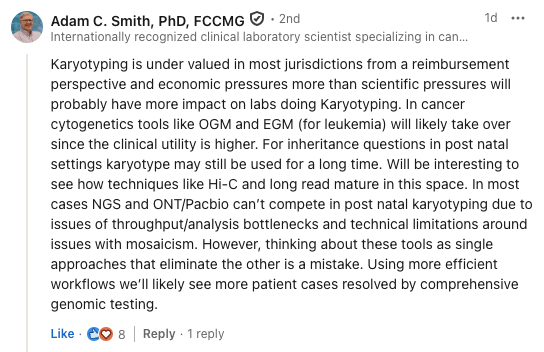
Adam C. Smith, PhD, FCCMG, shifted the discussion away from technology alone.
He argued that karyotyping is:
“under valued in most jurisdictions from a reimbursement perspective”
and suggested that economic pressures may affect laboratories more strongly than scientific pressures.
This is a significant point.
A technology can remain scientifically useful and still become difficult to sustain if laboratories are not adequately reimbursed for performing it. At the same time, a newer technology may gain popularity not only because it offers better resolution, but because it fits more easily into a laboratory’s financial and operational model.
Dr. Smith also pointed out that in cancer cytogenetics, technologies such as OGM and EGM may eventually take over some applications because of their clinical utility. However, he suggested that karyotyping may continue to be used for a long time in postnatal inheritance questions.
This suggests that the future of karyotyping will not be determined by scientific performance alone.
Other factors will matter too:
- reimbursement
- cost
- laboratory infrastructure
- turnaround time
- throughput
- interpretation
- clinical utility
A technically advanced test does not automatically become the routine test everywhere.
Perhaps the future is not about replacing one technology
Dr. Smith also made a broader point about how we think about technological change.
It is tempting to imagine that one technology will simply replace another:
Karyotyping will be replaced by CMA.
CMA will be replaced by NGS.
NGS will be replaced by long-read sequencing or genome mapping.
But real laboratory medicine rarely develops in such a straight line.
He noted that NGS and long-read platforms still face challenges in some postnatal applications, including throughput, analysis bottlenecks and mosaicism. His broader argument was that more efficient workflows may eventually allow laboratories to use comprehensive genomic testing to resolve more cases.
This may be one of the most important ideas from the discussion.
The future laboratory may not choose one technology and discard everything else. Instead, different technologies may contribute different layers of information.
Karyotyping may provide the chromosome-level view. CMA may identify smaller copy-number changes. NGS may detect sequence variants. OGM may help resolve complex structural rearrangements. Clinical interpretation may bring all of these findings together.
The goal is not to preserve one particular method.
The goal is to solve the patient’s diagnostic problem.
The role of the cytogeneticist is changing
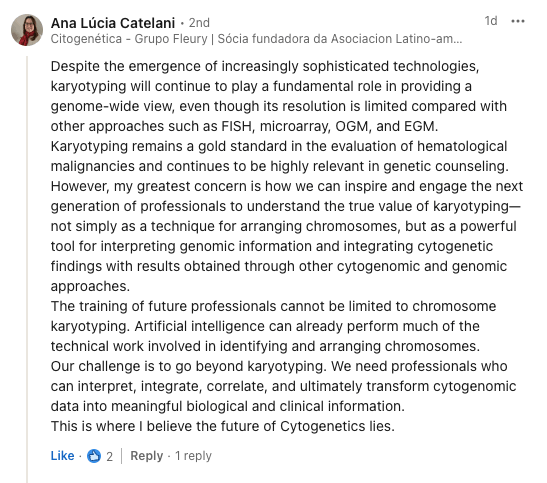
Ana Lúcia Catelani agreed that karyotyping will continue to have an important role, particularly because it provides a genome-wide view and remains useful in areas such as haematological malignancies and genetic counselling.
But her main concern was not only about the future of the technology.
It was about the future of the professionals who work with it.
She wrote:
“Our challenge is to go beyond karyotyping.”
She also pointed out that artificial intelligence can already perform much of the technical work involved in identifying and arranging chromosomes.
That observation changes the conversation.
If software can increasingly assist with chromosome identification, image analysis and karyotype arrangement, then technical proficiency alone may no longer be enough for the cytogeneticist of the future.
The more valuable skills may be the ability to:
interpret, integrate, correlate and explain.
A future cytogeneticist may need to understand karyotyping, CMA, sequencing, genome mapping and clinical information as parts of one diagnostic picture.
The profession may move away from asking:
Can you arrange the chromosomes correctly?
and towards asking:
Can you understand what the combined genomic findings mean for this patient?
The future may not be about becoming better at arranging chromosomes.
It may be about becoming better at interpreting the story those chromosomes are telling.
AI may change karyotyping without eliminating it
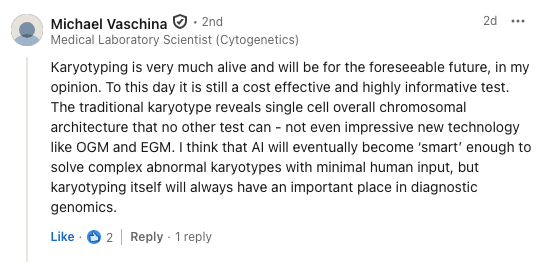
Michael Vaschina offered a more optimistic view of karyotyping’s future.
He described it as:
“very much alive”
and emphasised that it remains cost-effective and informative.
His most interesting point was that a traditional karyotype provides a single-cell view of overall chromosomal architecture. In his view, that information is not completely replaced by newer technologies such as OGM and EGM.
He also suggested that AI may eventually be able to solve complex abnormal karyotypes with very little human input.
At first, automation may sound like a threat to karyotyping. But it may also be the way karyotyping remains relevant.
AI could reduce the time required for routine analysis, assist with difficult cases and improve consistency. The technical workflow may change significantly while the underlying clinical information remains valuable.
In that sense, AI may not replace karyotyping.
It may help modernise it.
So, is karyotyping still relevant?
After reading the discussion, the answer does not seem to be a simple yes or no.
Karyotyping has clear limitations. Its resolution is lower than that of many newer molecular technologies, and some of its applications may gradually move towards OGM, sequencing or other genomic approaches.
But it would be premature to describe it as an outdated technology waiting to disappear.
Karyotyping still provides a broad chromosome-level view. It remains relatively accessible and cost-effective. It has established roles in reproductive genetics, constitutional cytogenetics, haematological malignancies and inheritance-related questions.
In some situations, it also provides information that is difficult to replace completely with a single newer technology.
The more likely future is not a battle between old and new technologies.
It may look more like:
Karyotyping + CMA + NGS + OGM + AI + clinical interpretation.
Each method may have a different role, depending on the patient and the question being asked.
The more important change may be in how these technologies are combined—and in how cytogeneticists are trained to interpret them.
The cytogeneticist of the future may not simply be the person who can produce a technically accurate karyotype. It may be the person who can connect chromosome data, genomic data and clinical information into one meaningful interpretation.
So perhaps the better question is not:
“Will karyotyping disappear?”
It is:
“What role will karyotyping play in the future of cytogenomics?”
The answer is still developing.
But one thing is clear from this discussion: karyotyping may change, become more automated and share space with newer technologies, but it is not yet ready to be written off.
A note from the author
This article began with a simple LinkedIn question about the future of karyotyping.
I did not want to provide a textbook answer. I wanted to hear from people who work with these technologies and see their strengths and limitations in real-world practice.
The responses did not produce a single consensus—and perhaps that is exactly what makes the discussion valuable.
Some contributors focused on the continuing clinical relevance of karyotyping. Others highlighted the growing role of sequencing, genome mapping and automation. Together, their comments suggest that the future of cytogenetics will be shaped by a combination of science, economics, accessibility and interpretation.
The views presented here are summaries of the perspectives shared by the individual contributors. They do not necessarily represent a single agreed position.
Thank you to everyone who took the time to share their experience, expertise and perspective.
This discussion is clearly not over.