Around 15–20% of deaths worldwide are linked to a condition in which death happens within minutes and without any warning signs.
I’m talking about Sudden Cardiac Death (SCD).
Over the past few years, SCD has gained a lot of attention, especially after several well-known celebrities died unexpectedly from heart-related events.
Unlike a heart attack, sudden cardiac arrest happens when the heart suddenly stops beating properly. A person loses consciousness, has no pulse, and without immediate treatment, death can occur within minutes.
Every passing minute reduces the patient’s chances of survival by 10%, the data say.
But this story is not about celebrities.
It’s about a family.
A family that seemed to carry a hidden risk through generation after generation.
Researchers eventually studied 74 members from the same family, spanning five generations. What they found was both fascinating and heartbreaking. Many family members were affected by an inherited heart condition, and several died suddenly at a young age.
Explore this case study to know more about how and why SCD happens.
Key Topics:
Key Clinical Information:
The condition affecting this family was Hypertrophic Cardiomyopathy (HCM), one of the most common inherited heart diseases.
In HCM, the heart muscle becomes thicker than normal, especially the wall that separates the two lower chambers of the heart. As the muscle thickens, it becomes harder for the heart to pump blood efficiently.
Thus, this increases the risk of abnormal heart rhythms, called arrhythmia, that can lead to sudden cardiac arrest. A patient may die immediately in majoriy of cases.
Affecting 1 in every 500 people worldwide, HCM is usually inherited in an autosomal dominant pattern. Researchers have identified more than 1,400 disease-associated variants across at least 27 genes linked to this condition.
In this case, every affected member of this family was diagnosed with HCM, although the severity varied from person to person.
Patient Summary:
The study was conducted by Guo et al. (2017) and the family history and case details were collected from Fuwai Hospital, National Center for Cardiovascular Diseases, Beijing, China.
The family consisted of 74 members across five generations, including 41 males and 33 females.
Among them, 25 individuals were diagnosed with HCM. Doctors confirmed the diagnosis using echocardiography. By the time the study was conducted, eight affected family members had already died.
The scans showed thickening of the left ventricular wall greater than 13 mm, a characteristic feature of HCM.
What makes this case particularly concerning is that many affected individuals had little to no symptoms before the sudden cardiac arrest episode.
What Genetics Revealed:
To understand what was happening, the researchers performed whole-genome sequencing and confirmed their findings using Sanger sequencing.
They identified a mutation called A719H in the MYH7 gene on chromosome 14. Interestingly, family members who carried only this mutation generally showed milder symptoms and maintained relatively normal heart function.
But that wasn’t the whole story.
The researchers also discovered another mutation, MYOZ2-L169G, in the MYOZ2 gene on chromosome 4. This variant appeared to act as a genetic modifier. This makes the disease more severe.
Family members who carried both MYH7-A719H and MYOZ2-L169G mutations had a much higher risk of severe disease and sudden cardiac death.
As younger generations appeared, additional variants in genes such as DNAJC19, CTNNA3, TTN, and NEBL were also identified. These extra genetic changes may have contributed to worsening disease severity and an earlier age of onset.
Another interesting finding was a 400-base pair deletion in the DNA region located between the MYH7 and NGDN genes. This deletion was found in four affected family members and may have played a role in disease progression.
The Most Fascinating Observation:
Now comes the most intriguing part of the story.
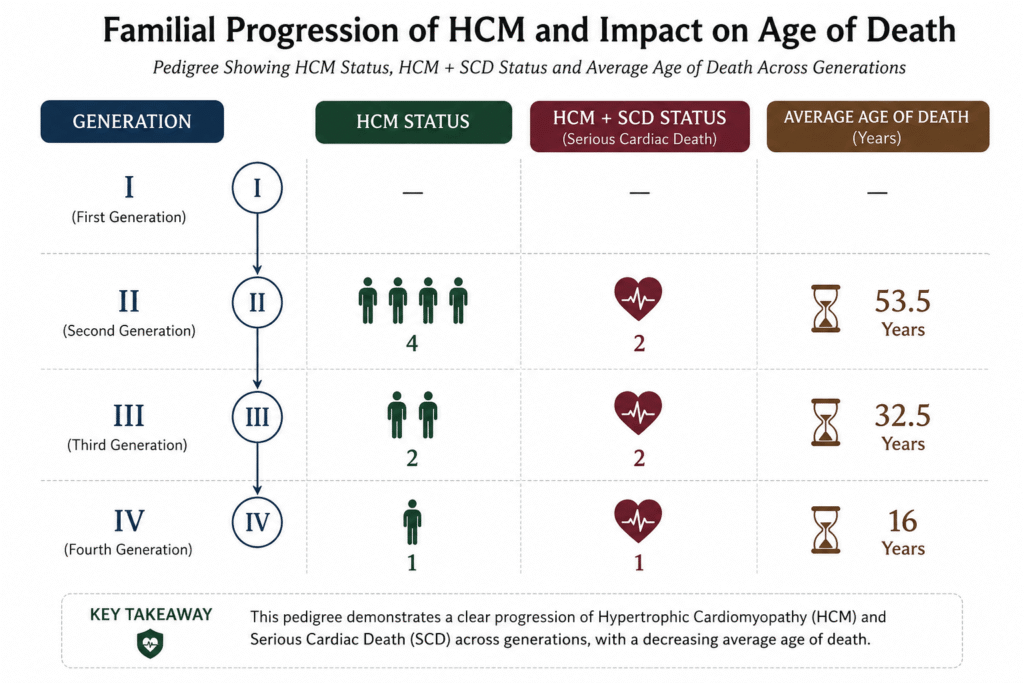
With each generation, the age at death became younger.
In the second generation, the average age of sudden cardiac death was 53.5 years.
In the third generation, it dropped to 32.5 years.
By the fourth generation, the average age was only 16 years.
Think about that for a moment.
The disease wasn’t just running in the family. It appeared to be striking earlier and becoming more severe with each generation.
This pattern is known as genetic anticipation, where a genetic disorder becomes more aggressive after every successive generation.
But there was another observation that caught the researchers’ attention.
According to the study, all affected family members who died experienced sudden cardiac death at around 8:00 AM, confirmed by two family members, independently.
Yes, around the same time in the morning.
The exact reason remains unknown.
However, the researchers suggested that an interaction between the underlying genetic defects and the body’s internal clock, the circadian rhythm, may be involved.
Blood pressure, heart rate, and stress hormone levels naturally rise during the early morning hours. In genetically susceptible individuals, these physiological changes may trigger dangerous heart rhythms (arrhythmia) that can lead to sudden cardiac death.
Key Learnings
This case highlights how powerful genetics can be when it comes to sudden cardiac death.
A family history of sudden cardiac arrest, unexplained fainting, hypertrophic cardiomyopathy, or sudden death at a young age should never be ignored.
If one family member is diagnosed with an inherited heart condition, close relatives may also benefit from medical screening and genetic testing. Early identification can help determine who may be at risk.
For high-risk individuals, an Implantable Cardioverter Defibrillator (ICD) can be life-saving. This device continuously monitor heart rhythm and can deliver a shock when a dangerous arrhythmia occurs.
Perhaps the most important lesson from this case study is this:
Serious cardiac events can occur even in people who appear healthy and have few or no symptoms.
Join Now:
Join the Clinical Genetics Orientation webinar to understand how genetics is used in diagnosis, genetic testing, and real clinical case interpretation. Click the link to join now!
Wrapping Up
Sudden cardiac death remains one of the leading causes of unexpected death worldwide.
While factors such as obesity, smoking, lack of exercise, stress, and existing heart disease can increase risk, genetics can sometimes play an equally important role.
This case study of a five-generation family is a good example showing that inherited genetic changes can be spread into the family and gradually become worse, after every generation.
However, understanding history, recognizing inherited risks, and considering genetic testing may help identify vulnerable individuals before tragedy strikes.
References:
Guo, Xiying, et al. “Genetic Anticipation in a Special Form of Hypertrophic Cardiomyopathy with Sudden Cardiac Death in a Family with 74 Members across 5 Generations.” Medicine, vol. 96, no. 11, 2017, p. e6249, https://doi.org/10.1097/MD.0000000000006249. Accessed 3 Jun. 2026.