
A healthy 30-year-old man was referred for genetic testing.
Not because he was sick.
Not because he had infertility.
But because his newborn daughter had multiple congenital abnormalities.
As part of the routine evaluation, doctors recommended parental karyotyping.
Nobody expected what came next.
The father’s chromosome analysis revealed an extra chromosome.
Surprisingly, he was completely healthy.
He had no developmental problems.
No intellectual disability.
He was fertile.
So how could someone carry an extra chromosome and still be perfectly normal?
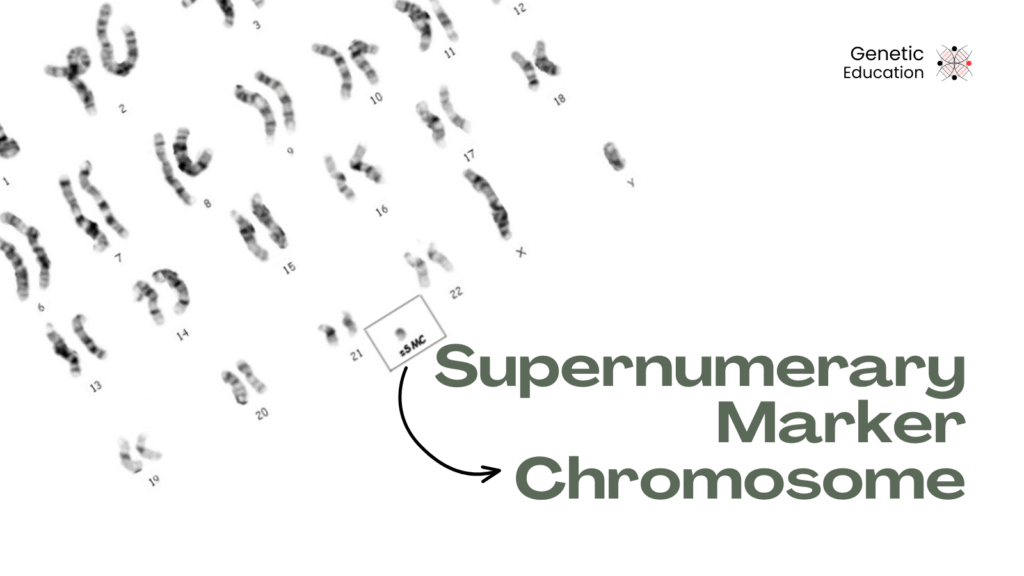
Let’s explore a unique case study of a mysterious human chromosomal abnormality known as “small supernumerary marker chromosome.”
Key Topics:
Key Clinical Information
sSMC (small supernumerary marker chromosome) is a unique type of numerical chromosomal abnormality. In this condition, an abnormal fragment of any chromosome (partial) is present in the karyotype, resulting in trisomy.
It is denoted as “+mar” in the ISCN and cannot be confirmed by conventional G-banding. Further investigations like FISH are needed.
To understand this more precisely, let’s break down the terminology.
Small means smaller than the smallest chromosome in the genome, which is chromosome 20.
Supernumerary means extra or additional to the normal pairs but not complete.
Marker means a structural rearrangement whose exact origin can not be detected by microscopy or GTG banding.
So, in combination, a type of structural rearrangement, which is smaller but defined as an extra chromosome, and can not be verified by conventional karyotyping, is known as a small supernumerary marker chromosome.
A report suggests that 3.2 million people are living with sSMC globally, with 70% being completely normal.
In addition, 70% of cases arise de novo (spontaneously without any reason), while only 30% are inherited.
Chromosome 15 is the most frequently reported chromosome involved in small supernumerary marker chromosomes (sSMCs). Overall, the majority of sSMCs originate from the acrocentric chromosomes 13, 14, 15, 21, and 22.
The clear mechanism behind sSMC is not well-documented; however, research suggests that it occurs during cell division, when chromosomes undergo breaking and abnormal rejoining events.
Studies also showed that carriers of sSMC represent a wide range of clinical variabilities based on ‘which’ and ‘how much’ chromosomal region the sSMC has.
Patient Summary
The patient was a healthy and fertile 30-year-old man.
He was referred for paternal karyotyping as his daughter was born with abnormal and dysmorphic features.
During the routine parental karyotyping, the father unexpectedly showed a mosaic karyotype with sSMC.
Genetic Investigations
Common genetic investigations performed in this case are:
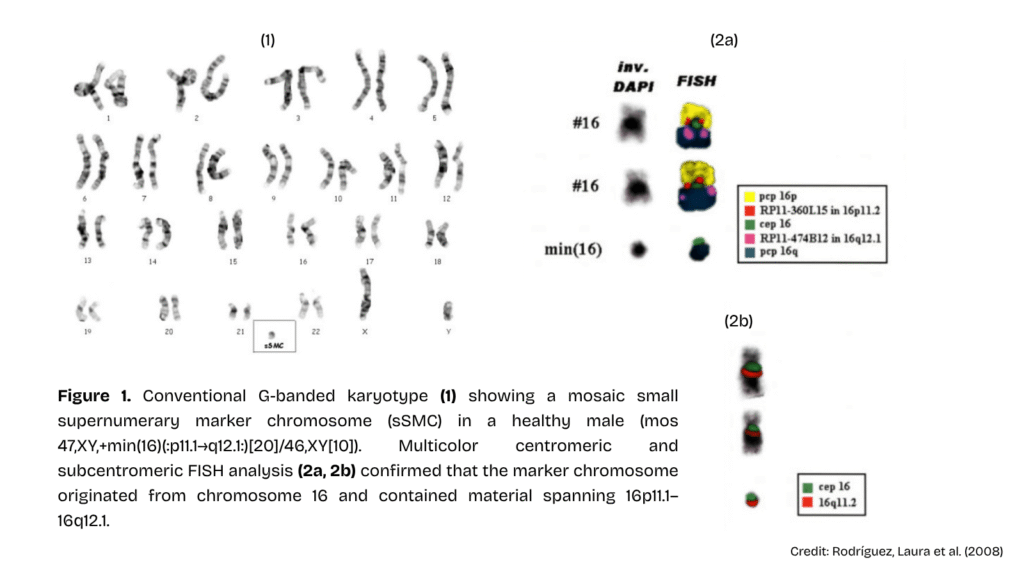
High-resolution G-banding: Used for parental karyotyping, revealed mosaic sSMC in the father and chromosome 2 deletion in the daughter.
Centromere-specific multicolor FISH: Used to investigate the sSMC in the father and the sSMC chromosomal origin.
Sub-centromere-specific multicolor FISH: Used to investigate which and how many additional chromosomal parts the sSMC has.
Glass needle-based microdissection & Reverse painting: Used for isolating the marker chromosome and mapping the chromosomal constituent.
Key Outcomes
Firstly, the daughter had a chromosome 2 deletion (46,XX,del(2)(q36.3)), which doesn’t have any correlation with the father’s sSMC.
mosaic small supernumerary marker chromosome was detected for chromosome 16 in the father (karyotype: mos 47,XY,+min(16)(:p11.1→q12.1:)[20]/46,XY[10]).
Let’s understand this karyotype:
Mos: shows mosaicism, meaning two different cell populations (one with sSMC and another normal).
+min(16): shows a minute part of chromosome 16 detected.
[20]/[10]: shows that 20 out of 30 metaphases have the marker chromosome while 10 are normal.
Genetics Explained
sSMCs are complex chromosomal abnormalities with highly variable clinical outcomes. Patients may present with a wide spectrum of phenotypes, ranging from completely normal to severe developmental and clinical disabilities.
The clinical significance primarily depends on the genetic content of the marker chromosome.
If the sSMC contains only heterochromatin, which is often the case, it usually has little or no clinical consequence because it lacks functional genes.
However, if it contains euchromatin, the gene-rich portion of the chromosome, it can result in copy number gain (partial trisomy), leading to developmental abnormalities or other clinical manifestations.
In this case, multicolor subcentromeric FISH demonstrated that the sSMC contained both heterochromatic and euchromatic regions. Despite the presence of euchromatin, the patient was phenotypically normal, making this an unusual and interesting case.
Key Learnings
Here are some of the key learnings from this case study:
- sSMCs are complex and unpredictable chromosomal rearrangements. They arise de novo and can not be inherited (in the majority of cases).
- Techniques like high-resolution G-banding aren’t sufficient to investigate such complex conditions.
- On the contrary, molecular cytogenetic techniques like centromeric & subcentromeric multicolor FISH and chromosomal microarray are significantly instrumental for determining sSMCs and copy number variations.
Join Karyo Club
A global community of cytogenetics learners and professionals dedicated to mastering chromosome analysis, FISH, ISCN nomenclature, and clinical case interpretation.
Wrapping up
Much like confined placental mosaicism (the case we discussed previously), the sSMC is also a rare, complex and unexpected chromosomal rearrangement abnormality.
Such conditions challenge our understanding of genetics and human health, but modern advancements like FISH and CMA help to effectively unfold the mystery.
This case study also showed that conventional karyotyping can not be an effective option for understanding complex chromosomal rearrangements.
Reference:
Rodríguez, Laura et al. “A new small supernumerary marker chromosome, generating mosaic pure trisomy 16q11.1-q12.1 in a healthy man.” Molecular cytogenetics vol. 1 4. 2 Apr. 2008, doi:10.1186/1755-8166-1-4.

Your blog is a constant source of inspiration for me. Your passion for your subject matter is palpable, and it’s clear that you pour your heart and soul into every post. Keep up the incredible work!