A child (pediatric patient) suffers from autoimmune thyroid, autoimmune hepatitis type II and insulin-dependent diabetes mellitus.
Also, a few developmental and neurological problems, showing varied levels and varieties of autoimmune diseases.
But what caused these abnormalities? And what does autoimmune disease mean?
Let’s find out.
Key Topics:
Key Clinical Information:
The present case represents a very common medical condition known as autoimmune disease. In this situation, our own immune system, which is meant to protect us, attacks the body’s healthy cells and tries to kill them.
Put simply, our own immune system is trying to kill us. However, it is not lethal but affects different parts or systems, including bones & joints, the blood system, nerve system, muscle and digestive system, endocrine system and many more.
It is one of the most common categories of chronic diseases and affects 8 to 10% of the world’s population. Scientists identified more than 80 different autoimmune diseases linked to various systems.
Although it is a multifactorial condition, genetic factors have been predominantly involved in causing autoimmune diseases, including gene mutations and chromosomal abnormalities. More than 300 genetic loci have been identified, linked to this condition.
Several common chromosomal abnormalities causing autoimmune diseases are Turner syndrome (XO), Klinefelter syndrome (XXY), and Down syndrome (trisomy 21) and various other trisomies and structural anomalies.
Patient Summary:
Here is the complete patient summary for the present case.
Patient: Pediatric female, aged 2 years and 7 months.
Family history: The parents are healthy, non-consanguineously married, but have a significant history of diabetes. The delivery was normal and noncomplicated.
Note: The patient is the second child; the first child was normal.
Symptoms patients showed over the course of time are listed here:
Early Symptoms (Onset between 9 and 23 months):
- Eating behavior disorder/difficulties with chewing and swallowing
- Poor height-weight growth / short stature (below the 3rd percentile)
- Global developmental delay
- Psychomotor developmental delay
- Hypotonia (low muscle tone) with ligamentous hyperlaxity (loose joints)
- Motor instability
- Microcephaly (small head size)
- Hypertransaminasemia (elevated liver enzymes/liver dysfunction)
Clinical Presentation (Physical & Structural Features):
- Asymmetric facial features
- Flat facial profile
- Sparse eyebrows
- Long eyelashes
- Periorbital fullness (puffiness around the eyes)
- Epicanthus (eyelid skin folds)
- Hypertelorism (widely spaced eyes)
- Large ears
- Depressed nasal bridge
- Broad nasal tip
- Asymmetric mouth and dental arches
- Thin upper lip
- High palate
- Protruded tongue
- Micrognathia (small lower jaw)
- Stumpy neck
- Umbilical hernia
- Small hands and feet
- Bilateral flat foot
- Clinodactyly of the IV toe (curved fourth toe)
Neurological Findings:
- Brain white matter abnormalities / millimetric hyperdense areas (indicative of gliotic reparative processes/scarring)
- Delayed myelination of the central nervous system (associated with the disrupted MBP gene)
- Global and psychomotor developmental delays
- Hypotonia (low muscle tone) with ligamentous hyperlaxity (loose joints)
- Motor instability
Autoimmune Disorders:
- Autoimmune Hepatitis Type II
- Chronic Autoimmune Thyroiditis
Genetic Status & Susceptibilities:
- Chromosomal Structural Anomaly
- SNPs in various genes
- Celiac Disease Susceptibility
- Insulin-Dependent Diabetes Mellitus (IDDM) Susceptibility
Genetics Explained:
Montanari et al. (2024) performed conventional karyotyping followed by SNP array to identify chromosomal abnormalities and genetic mutations linked with the present condition.
Cytogenetic investigation:
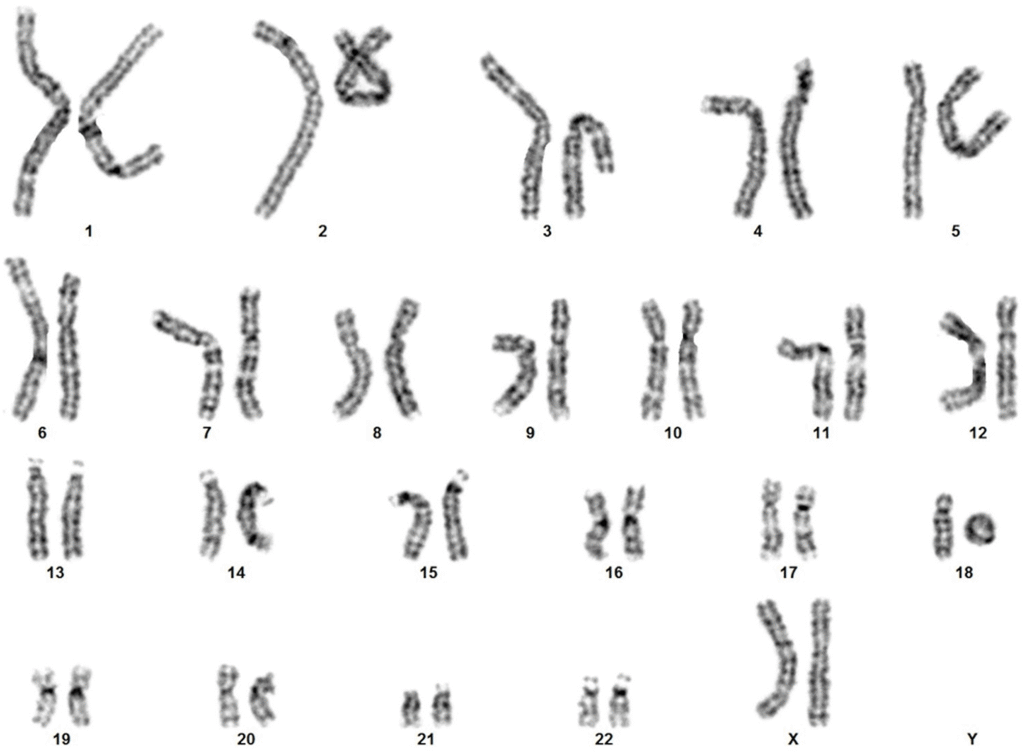
Cytogenetic investigation by karyotyping and GTG banding showed a ring chromosome 18, ISCN: 46,XX, r(18)(p11.3q23).
A ring chromosome is a rare chromosomal structural abnormality that occurs when the tip of the same chromosome, including the telomeres and some genes (depending on the size), is deleted, and the two sticky ends then fuse.
In this case or in general, a ring chromosome is a de novo event that occurs randomly during the development stage. Here, the ring chromosome 18 happens by a 10.4 Mb deletion on the p arm (18p11.32p11.22) and a 3.2 Mb deletion on the q arm (18q23).
This deletion, followed by the ring formation, leads to genetic imbalance/copy number alteration, causing varied degrees of abnormalities and autoimmune diseases in the patient.
Molecular analysis:
Molecular analysis by SNP (single-nucleotide polymorphism) array revealed that in total 46 OMIM genes are deleted, 36 from the p arm and 10 from the q arm.
The prominent finding of the SNP array was a mutation in the MBP gene, functioning in the central nervous system. The functional deficit of the present gene shows significant phenotype change and a strong genotype-phenotype correlation.
The report also showed a deletion of the GALR1 gene, another key gene for the nervous system. Check out the table below to know more about other candidate genes:
| Chromosome Arm | Location (Cytoband) | Key Genes | Representation |
| Short Arm (18p) | 18p11.32-p11.22 | LAMA1 | Autosomal Recessive |
| LPIN2 | Autosomal Recessive | ||
| NDUFV2 | Autosomal Recessive | ||
| TGIF1 | Haploinsufficient | ||
| Long Arm (18q) | 18q23 | CTDP1 | Autosomal Recessive |
| MBP | Disrupted (Breakpoint) | ||
| GALR1 | Deleted / Disrupted |
Key Observations:
Karyotype analysis and molecular investigation by SNP array showed that the deleted regions on p and q arms, followed by ring formation, consist of vital genes linked to various systems and, henceforth, caused disabilities and autoimmune diseases.
Copy number variants have been reported in various candidate genes with an autosomal recessive, deletion or disruption and haploinsufficient patterns.
Key Learnings:
- One of the major learnings from the present case study is that autoimmune diseases have a strong genetic foundation.
- Studies showed that chromosome 18 abnormalities- ring chromosome or deletion are actively involved in autoimmune diseases.
- Copy number variation or haploinsufficiency creates a genetic imbalance and, hence, autoimmune diseases.
- Conditions like ring chromosomes are random events and occur during the course of development; no parents or external factors contribute to this.
Previous Case Study: [Case Study #2]: Recurrent Pregnancy Loss in a Couple With Balanced Translocation.
Join Now!
Join our Karyotype Analysis Cohort and gain hands-on experience in chromosome analysis, karyogram preparation, ISCN nomenclature, and real clinical case interpretation. Learn from experts, strengthen your cytogenetics skills, and build confidence in reporting chromosomal abnormalities.
Enroll now and take the next step in your cytogenetics journey
Wrapping up:
Autoimmune diseases are common immunological problems reported worldwide. The present case study and many others showed that genetic factors have a huge contribution to the present condition.
Due to the involvement of multiple factors and multiple genetic problems, no clear early diagnostic or predictive screening is possible. However, the condition isn’t lethal. Lifestyle changes and medication can help manage autoimmune diseases. Doctor’s advice is needed.
Reference: Montanari, Annalaura, et al. “Clinical and Genomic Profiling of a Patient with a de Novo Ring Chromosome 18: A Case Report Highlighting Autoimmune and Neurological Implications.” Molecular Cytogenetics, vol. 17, no. 1, 5 Dec. 2024, https://doi.org/10.1186/s13039-024-00700-5. Accessed 18 June 2026.