Male infertility is a major global health concern. Among many contributing factors, genetics is a predominant cause of idiopathic male infertility.
The literature usually considers Y chromosome-linked abnormalities exclusively in relation to male infertility and as common causes of azoospermia. Although Y chromosome microdeletions are among the most common genetic causes, other Y-linked genes and autosomal genes can also cause male infertility.
But what if I tell you that there are many autosomal chromosomal abnormalities that not only cause male infertility but can also be inherited across generations?
This week, while exploring the genetics of male infertility, we reviewed several amazing and unique cases.
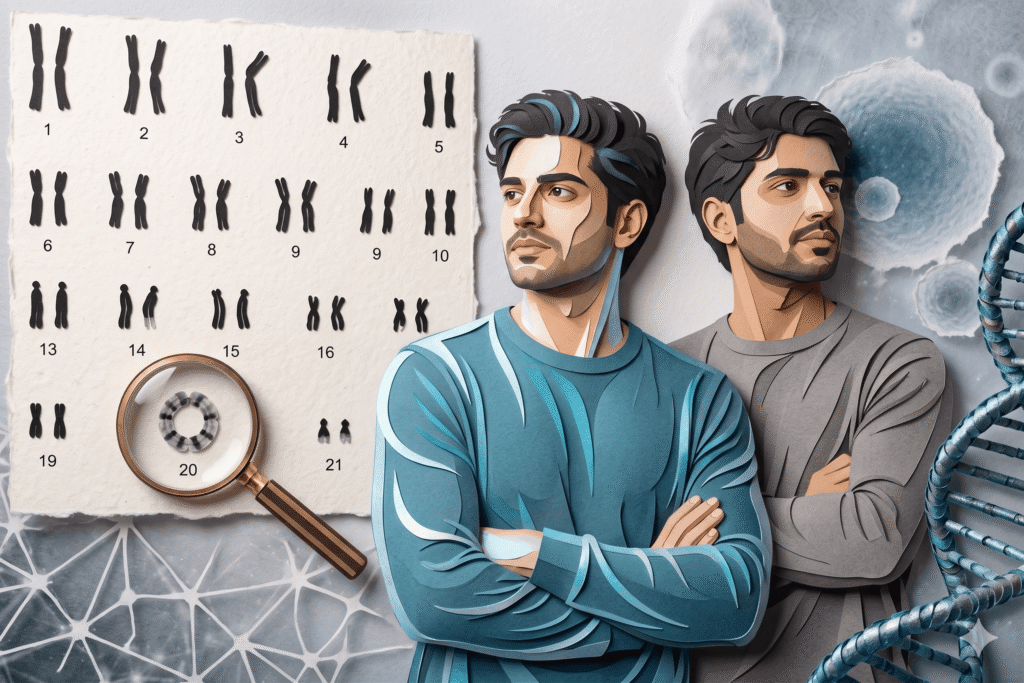
And this case is perhaps the most unique and interesting of them all: the role of a ring chromosome in male infertility.
Previous case study: [Case Study #3]: A Unique Case of Ring Chromosome and Autoimmune Diseases.
Key Topics:
Key Clinical Information
Male infertility is scientifically defined as the inability of a male to make his female partner pregnant after more than one year of regular unprotected intercourse. Among all infertility cases worldwide, male infertility contributes to approximately 50% of cases.
Globally, 5 to 7% of the male population experiences varying degrees of infertility. Genetic factors contribute to 15 to 30% of idiopathic (unexplained) cases of male infertility.
Interestingly, among these cases, chromosomal abnormalities (both autosomal and sex chromosomal abnormalities) account for approximately 2 to 5%. This number increases to as much as 15% in patients diagnosed with oligospermia or oligozoospermia.
Y chromosome microdeletion is the most commonly reported chromosomal abnormality, while other structural chromosomal alterations, Klinefelter syndrome, various genetic syndromes, and gene-level mutations have also been associated with male infertility.
In addition, lifestyle, medical conditions, personal habits, medications, and family history are other common contributing factors.
Patient Summary
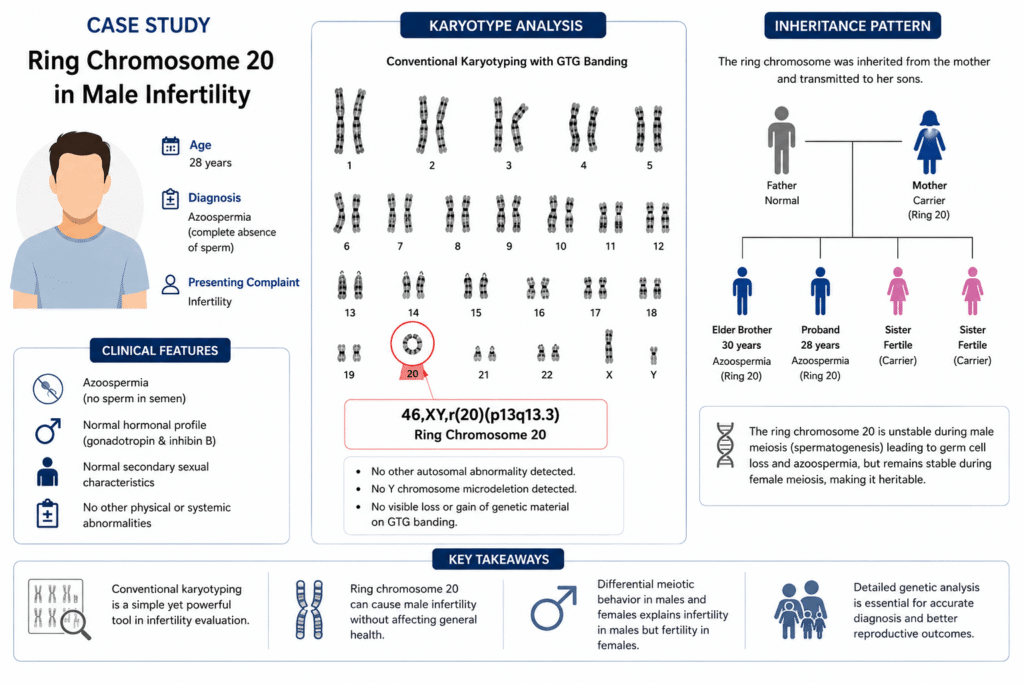
The patient was a 28-year-old male diagnosed with azoospermia (complete absence of sperm) and presented with infertility.
The patient’s hormonal profile, including gonadotropin and inhibin B concentrations, along with other reproductive phenotypes, was normal.
Interestingly, the proband’s elder brother (aged 30) was also diagnosed with azoospermia and carried the same structural chromosomal abnormality. The proband’s two sisters were completely fertile, while the remaining two brothers had not undergone any genetic testing.
Genetics Explained
Conventional karyotyping followed by GTG banding was performed.
The patient and his brother carried the same chromosomal abnormality, a ring chromosome 22, designated according to ISCN as: 46,XY,r(22)(p12q13.3).
No other autosomal abnormalities or Y chromosome microdeletions were reported during the analysis. The karyotype also showed that no visible chromosomal bands were lost during ring chromosome formation.
In simple terms, no detectable genetic material appeared to be lost or gained.
Key Outcomes
A ring chromosome is a unique structural chromosomal abnormality associated with various medical conditions. It is a rare genetic event that usually occurs spontaneously during meiosis.
Ring chromosomes often cause copy number imbalances because genetic material is commonly lost along with the terminal regions during ring formation. However, in this case, the scientists did not report any detectable genetic loss. Hence, practically no genes appeared to be missing.
As the exact same ring chromosome was identified in both brothers, the condition was presumed to be inherited from one of the parents.
But here comes the interesting catch!
Ring chromosomes behave differently during male and female gametogenesis. In males, the ring chromosome is highly unstable during meiosis, or spermatogenesis.
The cell attempts to repair it, but its circular structure interferes with normal chromosome pairing and recombination. This triggers meiotic abnormalities and often leads to germ cell death.
This is why ring chromosomes are commonly associated with extremely low sperm counts or complete azoospermia.
But the even more surprising part is this.
The same ring chromosome may remain relatively stable during female meiosis, making transmission possible through the maternal line.
Hence, the authors suggested that the ring chromosome may have been inherited from the maternal side of the family.
Key Learnings
- A seemingly simple and low-resolution technique such as conventional karyotyping remains a powerful tool for infertility investigations. Hormonal profiling and routine physical examinations alone are insufficient to rule out underlying genetic causes.
- Conventional GTG banding continues to be a valuable and effective technique for assessing male infertility.
- One of the key learnings from this case is that male and female reproductive biology differ significantly in terms of development, chromosome behavior, and genetic outcomes.
- A proper and validated diagnostic hierarchy that includes extensive genetic analysis is essential for accurate patient diagnosis and may ultimately improve IVF outcomes.
Join Now!
Join our Karyotype Analysis Cohort and gain hands-on experience in chromosome analysis, karyogram preparation, ISCN nomenclature, and real clinical case interpretation. Learn from experts, strengthen your cytogenetics skills, and build confidence in reporting chromosomal abnormalities.
Enroll now and take the next step in your cytogenetics journey
Wrapping Up:
Infertility is increasing globally, and sperm concentration has declined substantially over the past few decades. Although assisted reproductive technologies have improved patient outcomes, genetic analysis often remains underutilized.
This case study demonstrates how nature influences reproductive success while balancing the ultimate biological objective: the survival and continuation of the species.
Subscribe to Genetic Education for more amazing case studies.
Reference
Rajesh, H. et al. (2011). Azoospermia and paternal autosomal ring chromosomes: Case report and literature review. Reproductive BioMedicine Online, 23, 466–470.